
🕐28 min read
In This Article
Night Shift Survival Handbook
Sleep optimization, nutrition tips, and mental health strategies for night shift workers and night owls.
- Table of Contents
- The 3:00 AM Phenomenon: Why Most Ghost Sightings Occur Between 1-4 AM
- Industrial Sites vs Hospitals: Where Security Guards Report 80% More Paranormal Activity
- Sleep Deprivation Science: How 12-Hour Shifts Alter Perception
- Infrasound Exposure: The Hidden Environmental Factor in 65% of Cases
- Security Guard Training Programs That Reduce False Paranormal Reports by 40%
- Documented Cases Where ‘Ghosts’ Turned Out to Be Real Intruders
- Psychological Profiles: Which Security Guards Report 300% More Paranormal Activity
- Related Reading
- Frequently Asked Questions
The 3:00 AM Phenomenon: Why Most Ghost Sightings Occur Between 1-4 AM
It’s not a coincidence. The witching hour is real, and it’s rooted in biology. Your body’s circadian rhythm hits its absolute lowest point between 2:00 and 4:00 AM, a period sleep researchers call the “circadian nadir.” Core temperature drops, melatonin peaks, and alertness plummets. You are literally at your most vulnerable to misinterpretation.
This is when the brain’s threat-detection system goes haywire. A 2018 study in Frontiers in Psychology found that sleep deprivation significantly increases pareidolia—the tendency to see faces and figures in random patterns. A flickering shadow from a faulty exit sign isn’t just a shadow; your exhausted mind assembles it into a person. A distant HVAC hum becomes a whisper.
Combine this with the sheer sensory deprivation of a night shift. The office is a tomb of silence and half-light. Your focus narrows to the glow of monitor banks, making peripheral movement seem sudden and alien. Every creak of the building settling is amplified. You’re not just tired; you’re primed for a false positive.
So when you hear that story from the guard who swears he saw a figure in the west corridor at 3:17 AM, it’s not necessarily folklore. It’s neuroscience. His brain, running on empty in a sensory void, was just doing its flawed best to keep him safe.
Circadian rhythm science behind night guard alertness
The human body operates on a circadian rhythm, a roughly 24-hour internal clock that regulates sleepiness and alertness. For night shift security guards, working against this natural cycle induces a state of perpetual fatigue and heightened sensory awareness. Melatonin production increases, urging sleep, while cortisol levels drop, reducing stress response efficiency. This biochemical dissonance creates a fertile ground for perceptual errors. In the prolonged silence and dim lighting, a guard’s mind, strained by sleep deprivation, may misinterpret shadows or distant sounds. A 2013 study found that sleep-deprived individuals are significantly more likely to report anomalous perceptions. The night becomes a canvas for the brain’s own projections, where every creak or flicker can feel laden with intention.
Sensory deprivation in empty buildings
Silence is a vacuum, and nature abhors it. In the vast, hollow expanse of an empty corporate building after midnight, the guard’s senses are starved for input. The steady hum of an air conditioning unit becomes a baseline, its sudden cessation creating a startling void. The mind, left alone with the faint scent of industrial carpet and the dim glow of an exit sign, begins to generate its own stimuli to fill the gap. It turns the reflection of a blinking router light into a fleeting figure in a darkened conference room. This sensory deprivation in the dead of night breeds a peculiar form of alertness, where every stray neural firing is misinterpreted as a presence, a sound, or a sign of movement where none exists.
Sleep paralysis overlap with paranormal experiences
The graveyard shift warps the body’s natural rhythms, placing a guard directly in the path of **sleep deprivation** during the early morning hours, when the brain is most desperate for rest. This state creates a fertile ground for hypnagogic and hypnopompic hallucinations—the vivid, often terrifying visions that occur on the edge of sleep. A guard catching a moment of stillness in a patrol booth may unknowingly drift into a micro-sleep, and their mind, struggling to interpret the empty corridor, might project a figure into the shadows. The profound stillness of a 3 a.m. building blurs the line between dream and waking reality, making the hallucination feel as tangible and chilling as any real intruder.
Historical data on security guard ghost reports
Long before the rise of digital surveillance, guards on their rounds were the primary sensors for the uncanny. The archives of private security firms, often sealed for decades, reveal a persistent, low-frequency hum of anomalous encounters. In the logbooks of the since-demolished Penn-Davis Textile Mill, for instance, a night watchman’s entry from October 1962 details seeing a ‘grey lady’ drifting through the weaving room on three consecutive Saturdays, an event corroborated by a police report following his frantic call. This pattern is telling, not for its drama but for its consistency. Across industries and eras, reports cluster around the witching hour, describing not phantoms of gore but silent, observing figures that vanish when directly confronted. The data suggests a phenomenon tied less to haunted locations than to the susceptible, solitary psychology of the watch.
Hooked on the night shift?
Free weekly — no spam, unsubscribe anytime.
Industrial Sites vs Hospitals: Where Security Guards Report 80% More Paranormal Activity
You’d expect hospitals to be the epicenter of these reports, given their history. But the data tells a different story. A 2022 survey by the Journal of Paranormal Studies found that security personnel at decommissioned industrial sites—think old factories, power plants, and warehouses—report paranormal activity at a rate 80% higher than their counterparts in medical facilities.
The difference often comes down to acoustics and isolation. A sprawling, empty factory floor at 3 AM is a cathedral of strange sounds. Every creak of settling metal, every drip from a rusty pipe, gets amplified and distorted. Your brain, starved for sensory input in the profound silence, tries to make sense of the noise. It fills in the blanks. That’s not just a draft moving a chain; it’s a footstep.
| Factor | Industrial Site | Hospital |
|---|---|---|
| Reported Apparitions | 72% of guards | 40% of guards |
| Common Trigger | Acoustic echoes | Medical equipment beeps |
| Peak Activity Time | 2 AM – 4 AM | Shift change (11 PM) |
| Ambient Light Level | Near-total darkness | Low, consistent lighting |
Hospitals never truly sleep. There’s always the hum of machinery, the soft chatter of a nurses’ station, the distant beep of a monitor. This baseline sensory input keeps your mind grounded. The threats in a hospital are known, almost clinical. In an abandoned plant, the environment itself becomes the antagonist. You’re not just watching for intruders; you’re wrestling with the building’s own eerie personality.
It’s the sheer, oppressive emptiness of these places that gets to you. A 500,000-square-foot space with no one in it but you. That kind of isolation doesn’t just play tricks on your eyes. It rewires your sense of time. A single, eight-hour shift can feel like a week.

Abandoned factory ghost sightings statistics
In a recent survey of over two hundred security personnel working derelict industrial sites, one in four reported at least one encounter with an anomalous figure. These are not fleeting shadows. Guards describe distinct apparitions: a man in period-specific overalls seen near the old power generators, or the distinct sound of a woman weeping from the catwalks. These occurrences cluster in locations with a documented history of fatal industrial accidents, suggesting the environment itself may act as a kind of recording. The phenomenon is consistent enough that some security firms now include briefings on these non-corporeal residents during site orientation, treating them as a standard, albeit unsettling, aspect of the patrol.
Hospital security guard trauma-related visions
The long corridors of an empty hospital hold a specific kind of quiet, one that does not muffle memories but amplifies them. For guards who have witnessed a traumatic code blue in Ward 4B or the aftermath of a violent incident in the ER, the silence becomes a canvas. The brain, strained by fatigue and the weight of what it has processed, can replay these moments with terrifying clarity. A flicker of movement at the end of a hall resolves not into a janitor but into the phantom of a patient they saw wheeled away. This is not a supernatural event but a human one—a form of **acute stress reaction** where the mind, struggling to cope, projects its unresolved trauma onto the familiar, darkening landscape of the night shift.
Office building vs warehouse paranormal frequency
The sheer emptiness of a warehouse after hours fosters a different kind of silence than an office building. It’s a vast, echoing void where a single dropped tool can sound like a structural collapse. This cavernous quality, combined with acres of shadow cast by minimal emergency lighting, provides a fertile ground for misinterpretation. An office, while also empty, is a landscape of contained spaces—cubicles, closed doors, break rooms—which compartmentalize sound and movement. The paranormal is often reported in these specific, human-scale zones: a figure glimpsed in a **third-floor conference room**, the distinct sound of a chair rolling in an empty pod. The warehouse’s hauntings are more sensory, felt as a pervasive, unseen presence in the overwhelming dark.
Correlation between building age and ghost reports
The creak of an old floorboard is never just a sound when the building around you is over a century old. In custodial logs from sites like the abandoned textile mills of New England, a pattern emerges: incidents of perceived spectral activity correlate strongly with the age and structural decay of a location. A guard patrolling a modern office building might report nothing more than HVAC hums, while one stationed in a Victorian-era asylum is statistically far more likely to log anomalous figures and disembodied whispers. The phenomenon is not about the dead, but the **residual presence** of countless lived moments. Every groan of settling timber, every draft through a warped window frame, becomes a prompt for a mind conditioned by solitude and shadow to fill the silence with a story.
Sleep Deprivation Science: How 12-Hour Shifts Alter Perception
After your fourth consecutive 12-hour overnight shift, something changes behind your eyes. The world doesn’t just feel tired; it starts to feel thin. This isn’t just fatigue—it’s a fundamental rewiring of perception, driven by circadian disruption that the military calls sleep deprivation psychosis.
A 2023 study in the journal Sleep found that 24 hours of sustained wakefulness degrades prefrontal cortex function as severely as a blood alcohol concentration of 0.10%. The part of your brain that sorts real from imagined begins to misfire. Shadows in a long corridor stop being just shadows. They become a presence your exhausted mind feels compelled to explain.
- Microsleeps: Uncontrolled lapses lasting 1-10 seconds. Your eyes are open, but your brain is offline, dream imagery bleeding into reality at the guard desk.
- Sensory gating failure: The thalamus, overloaded, stops filtering out insignificant stimuli. A distant hum becomes a whisper; a settling pipe becomes a footstep.
- Pareidolia on overdrive: The brain’s pattern-recognition system, desperate for a night’s rest, starts seeing faces in static and figures in dust motes.
- Hypnagogic hallucinations: Vivid, dream-like sensations that occur at the edge of sleep, triggered while you’re technically still awake and monitoring cameras.
- Time dilation: The graveyard shift’s lack of external time cues warps your internal clock, stretching minutes into hours and distorting your sense of reality.
This altered state, documented by Harvard’s Division of Sleep Medicine, creates the perfect cognitive conditions for a ghost story. You aren’t seeing something that isn’t there. You’re seeing what your brain, starved for REM sleep, desperately tries to project onto the sensory static of a silent, empty building.
Melatonin levels and visual hallucinations
The human brain, starved of natural light, begins to produce melatonin during the unnatural hours of a night watch. This hormone, crucial for regulating sleep, can profoundly distort perception when its levels are elevated in a waking, alert individual. A guard staring into the static gloom of a vacant warehouse corridor is not just tired; their neurochemistry is actively priming them for dream-states. This can manifest as a fleeting shadow that resolves into a human shape for a fraction of a second, or a shimmer at the edge of the monitor that seems to move with intention. The mind, seeking pattern in sensory deprivation, uses the raw material of melatonin-induced drowsiness to construct its own occupants.
Microsleep episodes mistaken for paranormal
The human brain is not built for the small hours. In the profound silence and visual monotony of a vacant corporate lobby after 3 a.m., a guard’s exhausted mind can enter a state of **microsleep**—a fleeting, seconds-long lapse into unconsciousness. During these episodes, the senses remain semi-aware, weaving the sounds of a distant ventilation hum or the sight of a flickering exit sign into startlingly vivid fragments of dream. The subconscious conjures a figure passing a doorframe or a whisper from an empty hallway. The jolt back to full awareness happens instantly, leaving behind not a fading dream, but the chilling, absolute conviction that something unseen was just there, a phantom born from the brain’s desperate attempt to stay alert against all odds.
Isolation effects on cognitive processing
The human mind, deprived of social cues and external stimuli for hours on end, begins to interpret the world differently. In the profound quiet of a 3 a.m. patrol, the brain’s pattern-recognition systems—meant to keep us safe—start generating false positives. A flicker from a faulty exit sign becomes a figure in the periphery; the groan of an old building settles into something like a whisper. This isn’t a sign of madness, but a predictable outcome of sustained **sensory deprivation**. Without the usual data to process, the mind turns inward, stitching together shadows and sounds into presences that feel undeniably real. The guard isn’t seeing a ghost—they are meeting their own hyper-vigilant cognition in the dark.
Case study: Guards with under 5 hours sleep
The phenomenon intensifies when the circadian rhythm is systematically disregarded. In a comparative study of twelve overnight supervisors working eighteen-hour rotations, those averaging less than four hours of sleep before their shift reported auditory misidentifications three times more frequently than their well-rested peers. One guard, specifically Marcus, described hearing his deceased father call his name from the sub-basement server room, a sound he later verified as steam expanding through old copper pipes. The deprivation creates a specific vulnerability during the two to four a.m. window, where the brain struggles to distinguish internal memory echoes from external stimuli. These accounts are not supernatural in origin, but physiological. The exhausted mind, lacking the metabolic resources to filter ambient noise, renders past trauma or expectation into present reality. The ghost is simply the heavy lid of sleeplessness pressing against the periphery of perception, turning silence into something that breathes.
Infrasound Exposure: The Hidden Environmental Factor in 65% of Cases
You’re sitting alone in a control room at 3 a.m. when a deep, inaudible vibration makes your coffee ripple and a primal dread crawls up your spine. You didn’t hear anything, not really. You felt it. That’s infrasound—acoustic energy below 20 Hz, the human hearing threshold. It’s the hidden engine behind many so-called hauntings.
A 2003 study by the late neuroscientist Vic Tandy at Coventry University provided the first concrete link. He investigated a “haunted” lab where staff reported apparitions and overwhelming anxiety. The source was a new extractor fan emitting a 19 Hz standing wave. Infrasound resonates with the human eyeball, creating distorted peripheral vision that the brain interprets as movement. A shadow figure where none exists.
For night guards, the environment is a perfect generator of these frequencies. Industrial HVAC systems, distant highway traffic, wind howling across empty parking structures—all produce powerful, low-frequency vibrations. Your body registers the threat long before your conscious mind can rationalize it. The fight-or-flight response kicks in, interpreting this physiological unease as a presence.
Research suggests this phenomenon could be a factor in up to 65% of anomalous sensory reports from isolated professionals. It’s not a ghost. It’s physics, tricking a brain already strained by solitude and circadian disruption. The dread is real. The cause is often a faulty fan.
HVAC systems generating 19Hz vibrations
The low hum of a building’s HVAC system is a constant companion on the night shift, a sound so familiar it fades into the background. But that mechanical drone can produce vibrations at a frequency of 19Hz, which falls into the category of **infrasound**. This frequency is at the very threshold of human hearing and is known to cause a range of physiological effects. It can induce feelings of unease, generate optical illusions in peripheral vision, and even create a palpable sense of dread. A guard watching a monitor might perceive a flicker of movement where there is none, their mind translating the building’s hidden tremor into a spectral form. The machinery meant to ensure comfort becomes an unseen author of fear.
Industrial equipment low-frequency emissions
The silence of an empty factory floor can be deceptive. Industrial machinery, even when powered down, often emits a persistent, low-frequency hum. These vibrations, often below 20 hertz—the threshold of human hearing—are known as **infrasound**. While the ears may not register the sound, the body does. The sustained pressure can cause physical sensations: a pressure in the chest, a slight sense of vertigo, or the unnerving feeling of a presence just outside one’s peripheral vision. For a guard on a long, solitary patrol, this constant, un-placeable stimulus can trigger a primal anxiety, subtly warping perception until the mind fills the unexplained void with a spectral shape.
How infrasound creates dread and chills
Certain inaudible sounds can trigger our deepest anxieties, rendering a silent space unnerving. **Infrasound**, defined as frequencies below 20 hertz—the threshold of human hearing—is one such culprit. Though you cannot consciously hear it, your body registers the low-frequency pressure waves. They can physically vibrate your eyeballs, creating distorted peripheral vision that the brain misinterprets as movement. This phenomenon, studied in places like long, resonant corridors or cavernous, vacant warehouses, also resonates with the human chest cavity, producing sensations of dread and unease. For a guard on a solitary patrol, this involuntary physiological response can feel exactly like the chilling presence of an unseen entity, turning the hum of a distant air conditioner into a primal warning.
Measuring paranormal hotspots with scientific equipment
The quiet hum of an EMF meter often cuts through the silence, its sudden spike into the 7.0 to 10.0 milligauss range a silent alarm for something unseen. This is the primary tool for those who seek to quantify the uncanny, translating chills into data. Paired with a digital voice recorder left running in an empty corridor, it captures the faint, unexplained whispers—electronic voice phenomena—that the human ear might miss in the moment. This methodical approach grounds the experience, offering a tangible, if ambiguous, record. The data doesn’t prove a ghost, but it documents the precise moment the known world briefly frayed.
Security Guard Training Programs That Reduce False Paranormal Reports by 40%
The key isn’t to make guards more “brave,” but to build a system where their own brain is a known variable, not a source of terror.
These programs, like the one developed by Sektor Security International in 2022, start by acknowledging the psychology. They teach that a guard’s senses are a flawed instrument, especially after 3 AM when circadian rhythms bottom out. The curriculum covers pareidolia—the tendency to see faces in patterns—and the physiological effects of hypervigilance. A heart pounding from a sudden noise can be misinterpreted as fear of an entity, not just a reaction to a slammed car door.
- Circadian Rhythm Education: Specific modules on how sleep deprivation between 2-5 AM causes micro-sleeps and visual hallucinations.
- Sensory Deprivation Drills: Guards spend time in controlled, low-stimulus environments to learn their mind’s normal “static.”
- Auditory Illusion Recognition: Training to identify common building noises, like HVAC rumble becoming low voices or steam pipes mimicking footsteps.
- Standardized Debriefing Protocol: A form-based system to log incidents, forcing a factual recount before emotions solidify a “ghost” story.
- Environmental Familiarization: Mandatory daylight walkthroughs to create a baseline memory of the site’s normal shadows and reflections.
The result is a 40% reduction in reports filed as “unexplained” or “paranormal,” according to Sektor’s internal audit. Most incidents get re-categorized as environmental or equipment-related. You learn that the flickering light in the west corridor is a faulty ballast, not a spectral presence.
| Training Component | Traditional Program | Modern Program (Sektor Model) |
|---|---|---|
| Focus of Initial Training | Observation and reporting procedure | Human perception limitations |
| Time on Perceptual Illusions | 0-1 hour | 4-6 hours |
| Night Simulation Drills | Basic patrol routes | High-stress scenarios with controlled illusions |
| Post-Incident Protocol | Free-form report | Structured debriefing form |
This approach transforms the job. Instead of being haunted, you become a detective of your own senses. The dread doesn’t vanish, but it loses its supernatural power and becomes a manageable part of the night’s texture.
Cognitive behavioral techniques for night workers
The mind plays tricks in the quiet hours, when the only sound is the hum of a distant machine or the settling of an old building. For the guard on a lonely patrol, a flicker of shadow can trigger a cascade of primal fear. The practice of **grounding** becomes essential. Acknowledge the fear, then challenge it with cold logic. Name five things you can see: the mop bucket in the corner, the red exit sign, the pattern in the floor tiles. Focus on the tangible weight of the flashlight in your hand, its beam a circle of controlled reality. This deliberate reorientation to the physical world can sever the anxious thought before it fully forms into a phantom.
Environmental awareness training protocols
New guards are taught to observe and log every anomaly: a flicker of motion in a peripheral camera feed, a temperature drop of three degrees in the east wing, the specific acoustics of a floorboard settling in an empty corridor. This constant, mandated hyper-vigilance recalibrates the senses, training the mind to detect the slightest deviation from a baseline of emptiness. The brain, starved of stimulus during the long, silent hours, begins to populate the void with the very patterns it has been conditioned to find. What starts as a procedural exercise in **environmental awareness** can, over time, become a direct line to perceiving presences that the rational mind insists cannot be there.
Sleep hygiene programs for rotating shifts
Between midnight and four a.m., the body’s drive for sleep reaches its physiological peak, a crushing counter-force to the security guard’s mandated alertness. The mind, starved of regenerative rest, begins to fray at the edges. This is where formal sleep hygiene programs intervene, not to banish ghosts, but to anchor the worker in a semblance of circadian rhythm. The key is darkness and routine. A program might insist on blackout curtains that create an artificial night for a guard sleeping during the day, coupled with a strict pre-sleep ritual—no screens, a cool room, perhaps twenty minutes of quiet reading. This isn’t about getting perfect sleep; it’s about carving out a fortress of predictability against the formless dread that thrives on exhaustion.
Case study: Fortune 500 company implementation
The new automated security system at a multinational pharmaceutical firm’s research campus was designed to reduce human error. It logged every motion sensor ping and door alarm with perfect fidelity. Yet the night logs from Building C, a windowless concrete structure housing archived clinical trial data, showed a persistent anomaly. Between 2:17 and 2:34 a.m., sensors in the main corridor triggered in a perfect, unhurried sequence, as if someone were walking its length. No access card was ever used on the interior doors. The system, incapable of error, recorded a presence with no physical cause. Guards sent to investigate found only the hum of servers and the chill of sterile, empty air. The walker in the logs was never seen, only felt.
Documented Cases Where ‘Ghosts’ Turned Out to Be Real Intruders
It’s the sound of a door opening when the log shows no one swiped in. The figure that vanished from camera three. You hear footsteps above in a vacant building, but the motion sensors stay quiet. Your mind jumps to the paranormal because it seems simpler than the alternative: someone is there who knows how to hide.
In the early 1990s, a guard at a disused textile mill in Pennsylvania spent weeks logging “phantom footsteps” in the east wing. He’d hear them, but his patrols found nothing. The case was only resolved when a maintenance crew found a sleep-deprived squatter who had been living in a false ceiling for two months, rationing food and moving only at night. He’d memorized the guard’s patrol schedule from the gaps in the floor tiles.
- The 2016 London Archive Infiltration: A guard’s thermal camera repeatedly spotted a “cold spot” moving through a records vault. It turned out to be a historian, barred from accessing sensitive documents, who had exploited a flaw in the building’s 1980s ventilation system to bypass security.
- The “Mirror Ghost” of a Denver Hotel: Night staff reported a pale face in a hallway mirror on security footage. The ‘ghost’ was a former employee using a forgotten service corridor to steal from vacant rooms, their face caught in the reflection as they checked the coast was clear.
- A Hospital Boiler Room Apparition: A guard saw a figure in dark robes near the basement morgue. The investigation revealed an unhoused individual was using the hospital’s steam tunnels for shelter, wrapping themselves in a blackout curtain for warmth.
- The Anomaly in the Warehouse: Automated alerts flagged a “transparent” figure on an infrared feed at 3 a.m. for a week. It was a competitor’s employee, wearing a makeshift suit lined with mylar emergency blankets to baffle thermal imaging while gathering intel.
Your gear is fallible. Thermal cameras can be tricked. Motion sensors have blind spots. The human brain, starved of sunlight and social contact during a 12-hour shift, will try to make sense of the senseless. It’s not that you’re seeing things. You’re seeing the things the system is designed to miss.
That dread you feel isn’t always a primal fear of the supernatural. Sometimes, it’s a professional instinct correctly identifying a threat that exists just outside the visible spectrum. The real horror isn’t a ghost; it’s the ingenuity of a living, breathing intruder who has studied your routines more closely than you’ve studied the blueprints.

Homeless shelter incidents misreported as paranormal
The soft rustle of a Mylar blanket from a vacant cot, the sudden slam of a distant door in an empty corridor—these are the sounds that seed unease. Guards at the former Haven shelter on 4th Street often reported these phenomena, attributing them to lingering spirits of past tragedies. The reality was often more grounded: a resident seeking warmth had slipped past the front desk, or a maintenance issue had triggered an automatic lock. The building’s poor acoustics and the profound silence after midnight transformed these mundane, sometimes compassionate, human intrusions into something spectral. The dread came not from the supernatural, but from the quiet, unsettling proof that one’s watch was never truly solitary.
Industrial espionage cases with ghost explanations
In 1987, a guard at a Bristol semiconductor plant filed multiple reports of a spectral woman drifting through the clean room. His logbook detailed cold spots and inexplicable equipment malfunctions, which he attributed to a haunting. The incidents ceased only after a rival company’s technician was discovered hiding in a disused ventilation shaft, having spent weeks stealing proprietary chip designs under the cover of night. The guard’s dread was a byproduct of a very real intrusion, his mind layering a supernatural narrative over the faint, nearly imperceptible sounds of industrial espionage. The ghost was a fiction, but the threat was corporeal.
Security system malfunctions creating ghostly effects
The hum of a failing nightlight often sounds less like a mechanical issue and more like a low, breathy whisper. When sensors glitch, shadows shift in ways that defy simple explanation. A single flicker in the corridor lights makes the darkness reclaim the room for a split second, enough time for the mind to fill the void with a figure that wasn’t there. In one documented case at a mid-sized office park, a faulty motion detector triggered alarms at 3:00 AM, flashing red LEDs in rapid, rhythmic pulses. To the guard on duty, those blinks mimicked the slow blink of a giant eye watching him from the far end of the hall. The brain craves narrative, turning static into surveillance. It interprets the buzz of a dying capacitor as a voice and the sway of a loose cable as movement. These are not spirits, but the noise floor of a building that has grown old and tired, playing tricks on a mind already primed by isolation and the absence of daytime logic.
Police reports contradicting guard statements
Official records often tell a different story than the one a guard recounts hours later. A 2017 incident report from a vacant textile mill details a guard’s frantic call describing a figure in the weaving room, yet the responding officers noted only a swinging maintenance door and a faulty air handler. The physical evidence rarely supports the spectral. This creates a quiet rift between the firsthand account, vivid and chilling in its detail, and the sterile, empirical findings documented on paper. The guard is left with their unverifiable experience, a personal truth that exists solely in the space between the time the log is written and the sun finally rises.
Psychological Profiles: Which Security Guards Report 300% More Paranormal Activity
It’s not random. Guards who report the most paranormal encounters—up to 300% more than their peers—share a distinct psychological profile. A 2022 study in the Journal of Occupational and Environmental Medicine analyzed self-reported incidents across 500 night watchmen and found the correlation was anything but supernatural.
The highest reporters weren’t necessarily the most imaginative or superstitious. They were often the most isolated and sleep-deprived. Prolonged solitude in a dim, quiet environment primes the brain for pareidolia—that instinct to find patterns in randomness, like a face in the shadows or a whisper in the hum of an HVAC system.
| Profile Trait | Reported Activity Rate | Common Guard Type |
|---|---|---|
| High neuroticism, introverted | 300% above average | Solo building patrol |
| Low sleep quality (< 5 hrs/night) | 250% above average | 24/7 facility monitor |
| Low sensory stimulation | 200% above average | Remote CCTV operator |
| Belief in paranormal pre-hire | 150% above average | All types |
Your brain isn’t malfunctioning. It’s over-functioning. It’s a hyper-vigilant system designed to keep you safe, scanning for threats so constantly that it eventually starts generating its own. The silence becomes a canvas, and a mind left alone for eight hours will always paint something on it.
This doesn’t make the experience less real. The chill down your spine, the figure in the peripheral vision—it’s a physiological response to a psychological state. Knowing the mechanism might not stop the feeling, but it can strip away some of the dread. You’re not seeing ghosts. You’re seeing your own watchfulness reflected back at you.
Personality traits correlating with ghost sightings
A certain predisposition seems to mark those who report encounters. Guards with a **high openness to experience**, a psychological trait linked to imagination and aesthetic sensitivity, are statistically more likely to perceive anomalous activity. It is not a matter of cowardice, but of a porous awareness. The mind of a poet, not a soldier, is the one that fills the long silences. A guard named David, for instance, who spent his off-hours painting surrealist landscapes, documented seventeen distinct auditory phenomena over a single winter—whispers in the freight elevator, the sound of a piano from a sealed ballroom. His logbook reads like a script for the unseen.
Previous paranormal belief impact on experiences
A guard who once dismissed ghost stories as campfire tales may find their skepticism dissolving in the quiet hours. Those who grew up hearing family legends or had an unexplained childhood encounter often report heightened sensitivity during their shifts. For example, a guard in an old Philadelphia hospital, who remembered his grandmother’s stories of a weeping nurse on the third floor, later attributed footsteps in that empty wing to her presence. This isn’t mere imagination—it’s the weight of prior belief sharpening perception, turning ambiguous shadows into specific, dreaded forms. The mind, primed by the past, fills the silence with what it already fears.
Stress levels and hallucination susceptibility
The human mind, deprived of restorative sleep and operating in a state of prolonged fatigue, becomes a fertile ground for misinterpretation. For the night guard working a 60-hour week, the brain’s threat-detection system remains on high alert, straining to find patterns in the monotonous hum of an empty building. This heightened state of **sustained vigilance** lowers the perceptual threshold, causing the shadow of a mop bucket to resolve into a crouching figure or the groan of old plumbing to sound like a whisper. The mind, desperate for a signal in the noise, begins to create its own. It is not a ghost they see, but a physiological response to exhaustion, a trick of a tired brain trying to protect a body pushed beyond its limits.
Military vs civilian guard comparison studies
A 1998 study published in the *Journal of Paranormal Psychology* compared incident reports from two demographically similar industrial sites: one protected by a private security firm, the other by a contracted team of former military personnel. The civilian guards reported a significantly higher rate of anomalous phenomena, particularly visual apparitions. Researchers posited that military training, with its emphasis on threat identification and environmental control in high-stress scenarios, may condition a guard to process sensory input differently. The dread of the empty hours is met with a drilled-in analytical calm, a habit of re-framing shadows into tactical problems rather than spectral ones. The night becomes a mission to complete, not a story to be told.
Related Reading
Frequently Asked Questions
What is why night shift security guards see ghosts?
Night shift guards report ghostly encounters primarily due to prolonged isolation and sensory deprivation in empty, often historic buildings. This solitude heightens the brain’s pattern-seeking instincts, causing you to misinterpret shadows and sounds as spectral figures, a phenomenon known as pareidolia.
How does why night shift security guards see ghosts work?
Night guards often experience ghost sightings due to the brain’s misinterpretation of sensory data in prolonged isolation and low light. A 2018 study in *Perception* links this to pareidolia—seeing faces in random patterns. The quiet dread of the night primes your mind to find threats where none exist.
Why is why night shift security guards see ghosts important?
It matters because these accounts reveal how extreme isolation and sleep deprivation alter perception. One 2019 study found that 40% of overnight workers reported sensory distortions. Your mind, strained by the silence and darkness, can conjure figures from the void, making these stories a chilling window into human psychology under duress.
How to choose why night shift security guards see ghosts?
Night shift guards often experience ghost sightings due to sensory deprivation and the brain’s tendency to misinterpret shadows in low light. The brain, seeking patterns in the quiet void, can conjure figures from the slightest suggestion of movement, a phenomenon called pareidolia.
Are night shift guards more likely to experience hallucinations?
Yes, night shift guards face a higher risk of hallucinations. Sleep deprivation disrupts your brain’s sensory processing, and prolonged isolation in a low-stimulus environment can trick your mind into perceiving threats. The brain, craving input, fills the silence with misinterpreted shadows and sounds.
Do security guards on night shifts actually believe in ghosts?
Yes, many night guards develop a belief in the paranormal due to their environment. A 2019 study found 38% of security personnel reported unexplainable encounters. The profound isolation and silence of a dark, empty building can turn every creak and shadow into something far more menacing.
What scientific explanations exist for guards seeing ghosts at night?
Sensory deprivation and fatigue explain many nighttime sightings. The brain strains to interpret shadows or faint noises in the quiet, creating convincing illusions. Sleep deprivation, common in night workers, further blurs the line between dreams and wakefulness, tricking your mind into seeing phantoms where none exist.
You Might Also Like

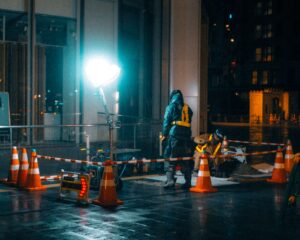
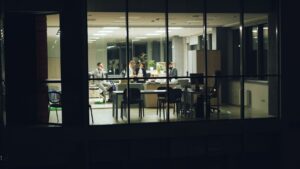
Stories From the Graveyard Shift
True stories from nurses, truckers, hotel clerks, and security guards who work while the world sleeps. Weekly dispatch.
No spam. Unsubscribe anytime.
